



Nowadays, software is the basis for the development of any business, more and more applications are needed to sell and generate profits and to be able to reach customers by offering them a good service and a good product, the software that was only applied to specific sectors within an organization has been left behind.
In today’s digital era, businesses have evolved and modernized. They are becoming more and more digital, and these companies need to offer quality software. For that they must implement this quality from the beginning and often do not know where to start.
At SIPSA we are going to give our approach on how we have implemented our quality system. It is an approach that is valid for any type of industry or business. Whether it is for large, medium, or small companies. Experience is showing us that any of them, regardless of their size, have the same concern and ask themselves the same question: How to implement software quality in my organization?
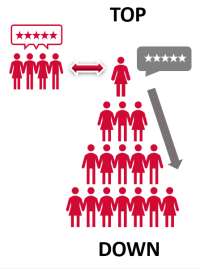
Quality in organizations must be implemented from top to bottom. It is the CEO who needs to see the needs of software quality, he must understand that quality is necessary and based on that need create a Quality Area that is built as a team and can support the decisions made from the top level. From that moment on, these measures will be transferred to each of the people belonging to the organization, managing to implement them.
The Quality Area/Team focuses on providing transparency in terms of quality. It advises decision-makers by transmitting to them all information related to the overall analysis of quality.
This Quality Team does not have enough power to move all the employees in an organization, but if we go from top to bottom, then it is possible.
To let such organizations, know how important quality is, we need to move from this project management to a broader view of project quality.
From PMO to QMO
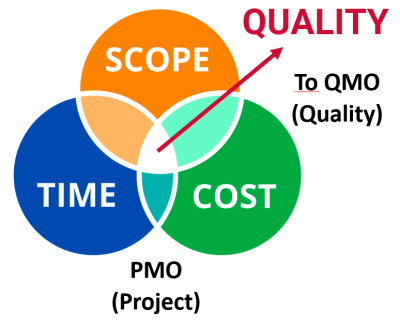
In any SW project there are three variables:
- We have the scope which is the functionality we want to cover.
- We also need to consider the time it takes to implement the solution and provide the solution to the end customer.
- And finally, we need to consider the cost.
These variables are important, but it is the intersection of these that gives us the quality that we are offering to our end customer.
Until now, projects have been managed by a PMO (Project Management Office) team, but these teams must be transformed into QMOs (Quality Management Offices), so that management not only considers the three variables: scope, time and cost, but also the impact on the quality of the software.
The quality management office performs constructive, analytical and efficient quality control services, guaranteeing an “end-to-end” vision. They are able to understand and control from the beginning to the end the different projects that are executed in the organization, to know what is the status of the project, in which phase they are, what are the risks that may be faced, provide this vision and what may be the impact and also offer the best sustainable solution, analyze all situations that may arise, thanks to the tools that help to monitor or track, the entire life cycle of the project; thereby assisting senior management in making decisions based on quality rather than just on project management.
The characteristics of a QMO, among others, are the following:
- Quality team, experts in quality implementation.
- Self-critical.
- Efficient team.
- Agile organization.
- Analyze the information of the E2E organization from tools.
- The quality engineer conveys the overall vision to decision makers.
We can measure the quality of the activities of the different teams involved in the project based on the use of tools. Nowadays companies mostly have tools that support such activities from the beginning to the end and help us to monitor or track the requirements, the scope of the projects, to understand what are the activities performed by the different teams, development teams and the different deliveries or releases of the software. Also, to know what the quality of those releases is. So, this QMO area will have a complete description of the different tools that are measuring the projects and, in this way, analyze the quality of the project based on reality, based on what the teams in the organization are recording.
Finally, we have a third level that is important for the quality team, and that is to involve the end users or end customers. To be able to understand what their needs are in terms of quality and to be able to measure them. Their participation is fundamental because it will give us the key and the real value. We must not forget that they are going to buy the company’s services, or the different products provided by the organization. And the final product must meet their expectations and provide them with a highly satisfactory solution. We are implementing this model and it is being well received by the different organizations we are working with. They are aware that we take their opinions into consideration and understand their needs.
Conclusions
- Quality is applied from top to bottom.
- The organization must move from the PMO to the QMO.
- QMO model to maximize project productivity by centralizing quality tools, involving the end user and automating processes.
The first thing we consider applying quality is that it must be implemented from the top down.
Today we are facing the situation where really the top management and the top level of the organizations are considering the software quality teams as the key elements to ensure the quality and the development of their business in the right direction. Our recommendation is that organizations move from having a PMO team where they develop projects, to being QMO quality management offices considering quality and efficiency over quality as the key element for success. This means that project management is carried out not only considering the three variables: scope, schedule, and costs, but also the impact on the quality of the software.
At SIPSA we have identified a model that is helping us to maximize the productivity of the projects, by introducing a quality specialist team, using project management tools to record the activities of the teams from start to finish, thinking of automation as a key element.
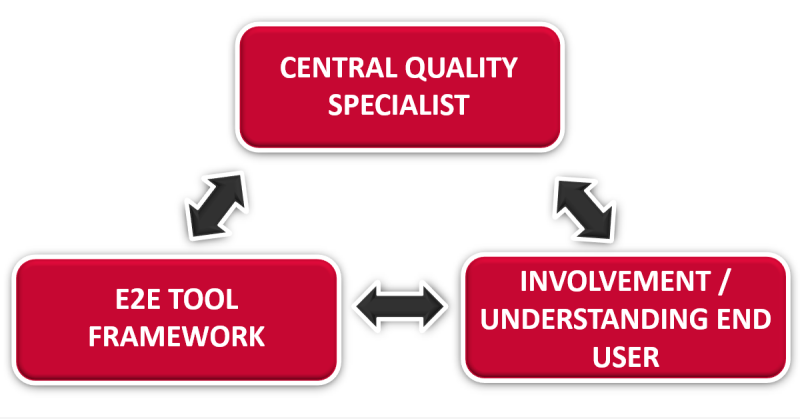
And finally, considering that the end user is the key element to ensure quality, it is necessary that this QMO team understands that they must be involved in the project. When this is not possible, it will be necessary to put ourselves in their place, understand them, know their needs and priorities, and take them into account when making decisions that may have an impact on the quality of the product.
If you are interested in learning more about our quality implementation model “Spherical Quality“, you can contact us without any obligation by clicking here.
We leave you this link where you can see the video presentation of Inma Alarcón, our CTO, TAST (Test Automation System Tool) Product Owner and creator of the Spherical Quality model, in which she explains how and why PMO teams should become QMO teams.




Leave A Comment
You must be logged in to post a comment.