



Strategies to modernize complex systems without compromising operations
Today, digital transformation is not just an option—it’s a necessity for any company that wants to remain competitive in a constantly evolving market. However, carrying out a digitization process in a large organization is no easy task. Technical, organizational, and cultural challenges arise that can slow down the process or, in the worst-case scenario, jeopardize its success.
At SIPSA, we’ve worked with companies such as Banco Santander in Germany and BMW, helping them overcome these challenges with well-defined strategies and innovative solutions. Through this experience, we’ve identified the main obstacles large organizations face in their path toward digitalization—and more importantly, how to overcome them.
Main challenges of Digital Transformation
Every organization is unique, but there are recurring challenges that many companies face when modernizing their operations. These are some of the most common:
-
Resistance to change
One of the biggest hurdles in any transformation process is resistance from teams. Employees often see digitalization as a threat to their jobs rather than an opportunity to improve their daily work. The key lies in effective communication from the outset. Explaining the benefits of the change, involving all departments early on, and offering proper training makes the transition easier and reduces resistance.
-
Integration with legacy systems
Many companies operate with legacy systems that have been the backbone of their business for years. These systems can hinder the adoption of new solutions without disrupting business operations. A progressive integration strategy is the best approach. Instead of replacing everything at once, systems can be modernized in phases, ensuring compatibility with new technologies and minimizing risk. At SIPSA, we apply methodologies that make this process easier without impacting business continuity.
-
Ensuring quality and efficiency
Automating manual processes brings multiple benefits, but it also means ensuring that the new tools work efficiently and without errors. Continuous validation is key. With TAST, we automate end-to-end testing at every phase of the digital transformation process, ensuring that changes are functional and efficient before full implementation.
-
Scalability and sustainability
Not all digital solutions are built to scale with the business. A common mistake is implementing tools that work now but become obsolete or limiting in a few years. It is essential to design a future-proof digital strategy. At SIPSA, we help companies develop scalable solutions that adapt to market changes and business evolution.
The 6Rs of Digital Transformation: key strategies to modernize enterprise systems
When a company decides to go digital, one of the first questions is what to do with its current systems. There are six strategic approaches that can guide this process, known as the 6Rs of digital transformation:
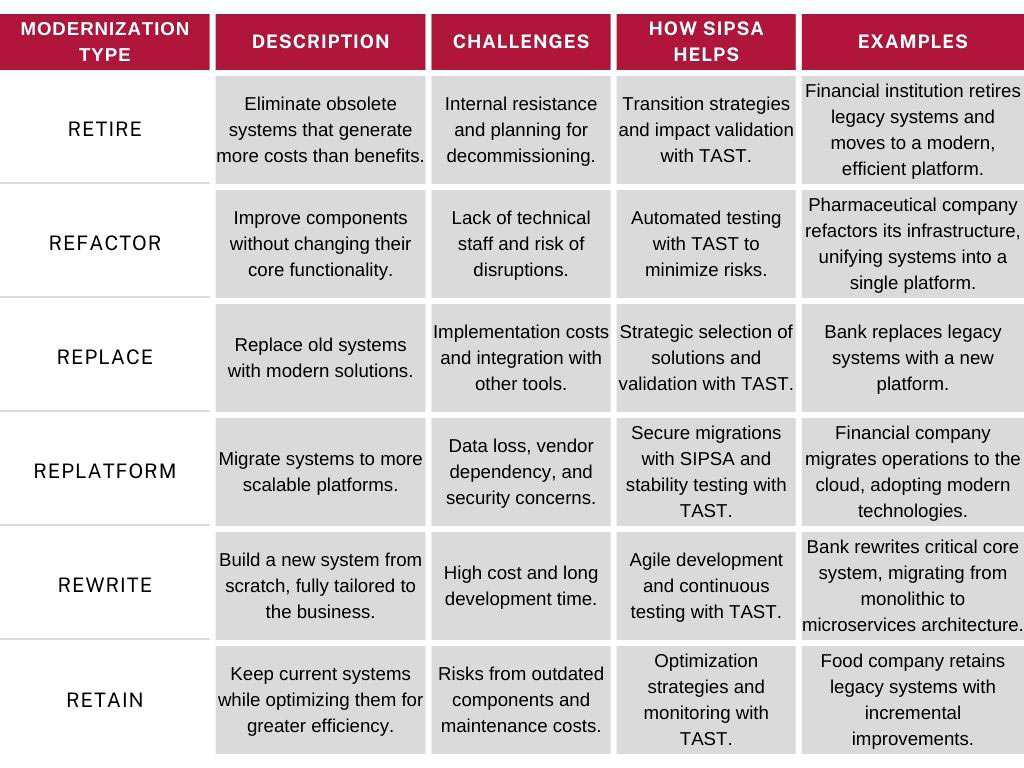
1. Retire
When a system or tool no longer adds value and only generates unnecessary costs, the best option is to eliminate it. To minimize the impact, a well-planned strategy is required to ensure operational continuity.
Example:
A financial institution implemented a strategy to retire obsolete legacy systems, consolidating operations onto a more modern and efficient platform, resulting in significant cost reduction and improved efficiency.
2. Refactor
Instead of replacing an entire system, some components can be improved without changing its core functionality.
Example:
A pharmaceutical company faced challenges with disparate systems in its manufacturing plants. It refactored its technology infrastructure, unifying systems into a single enterprise platform, improving efficiency and internal communication.
3. Replace
When a system no longer meets business needs, replacing it with a new solution is the best option.
Example:
A banking institution overhauled its core banking technology, replacing legacy systems with a new platform to boost competitiveness and efficiency.
4. Replatform
Migrating technology infrastructure to a more modern platform, such as the cloud, improves scalability and reduces operational costs.
Example:
A financial services organization moved its operations to the cloud, adopting modern technologies to enhance agility and efficiency.
5. Rewrite
In some cases, the best option is to build a new system from scratch, tailored to the company’s specific needs.
Example:
A banking entity rewrote its critical core system, migrating from a monolithic architecture to microservices, improving scalability and maintainability.
6. Retain
If a system still meets business objectives, it can be retained with some improvements and preventive maintenance to extend its lifecycle.
Example:
A consumer goods company retained certain functional legacy systems, implementing incremental improvements and ensuring integration with new technologies, allowing a smoother digital transition without disrupting existing operations.
How SIPSA Drives Digital Transformation in Large Enterprises
At SIPSA, we not only define digital transformation strategies—we accompany companies at every stage of the process to ensure changes are effective and sustainable. Our experience with large companies has allowed us to develop methodologies that ensure success in digitalization.
How we do it:
- Design strategies aligned with business objectives.
- Apply agile methodologies to ensure effective transitions.
- Automate the end-to-end testing process with tools such as TAST to ensure quality and efficiency.
- Focus on the sustainability and scalability of each solution.
Digital transformation doesn’t have to be a path full of obstacles. With the right approach and a well-structured strategy, companies can modernize successfully and remain competitive in the market.
Is your company ready to take the next step? Contact us.




Leave A Comment
You must be logged in to post a comment.